Request a quote
When launching a new product line, ensuring that your ASTM F963 custom toys pass rigorous US safety regulations can feel incredibly overwhelming. We understand the anxiety that B2B buyers face when navigating the complexities of the Consumer Product Safety Commission (CPSC). The fear of shipping delays, customs seizures at the Port of Long Beach, or unexpected compliance lawsuits is a heavy burden for any procurement manager or brand director to carry.
But you do not have to carry it alone. As your dedicated manufacturing partner, FactoryPlush is here to protect your investment and simplify the entire legal process.
We believe that compliance should never be a roadblock to your success; it should be a built-in feature of your supply chain. In this comprehensive guide, we strip away the legal jargon and show you exactly how we engineer your products to pass US toy safety regulations. Below, we will walk you step-by-step through our protocols for guaranteeing a lead-free plush, navigating phthalate restrictions, passing flammability tests, and helping you effortlessly secure your mandatory Children's Product Certificate (CPC). Our ultimate goal is your peace of mind.
The Consumer Product Safety Improvement Act (CPSIA) strictly regulates heavy metals in children's products to protect public health. To legally enter the US market, the total lead content in your custom plush toy's fabrics, zippers, and inks must not exceed 100 parts per million (ppm), mandating the manufacture of a 100% lead-free plush.

One of the greatest risks B2B buyers face when sourcing overseas is hidden chemical contamination. Many well-intentioned brands design beautiful products, only to discover during third-party lab testing that their factory used cheap, lead-contaminated screen printing inks to cut costs. By the time the lab issues a "Fail" report, the bulk order is already finished, resulting in catastrophic financial loss.
We refuse to let that happen to your brand. At FactoryPlush, we view chemical compliance as a non-negotiable prerequisite, not an afterthought.
To protect your brand from CPSC violations, you must understand how lead restrictions are enforced. The US government enforces a dual-layered restriction based on the component type:
We relieve you of the burden of chemical auditing. As a responsible plush toy factory USA standard, we aggressively police our raw material supply chain. We do not buy fabrics from unverified open markets. We require our fabric mills and dye houses to provide verified, batch-specific chemical analysis reports before the raw materials are allowed onto our cutting floor.
By proactively utilizing pre-certified, non-toxic dyes and inks, we guarantee that your final product will sail through the rigorous heavy metal migration tests required by CPSC-accepted laboratories, saving you time and money on re-testing.
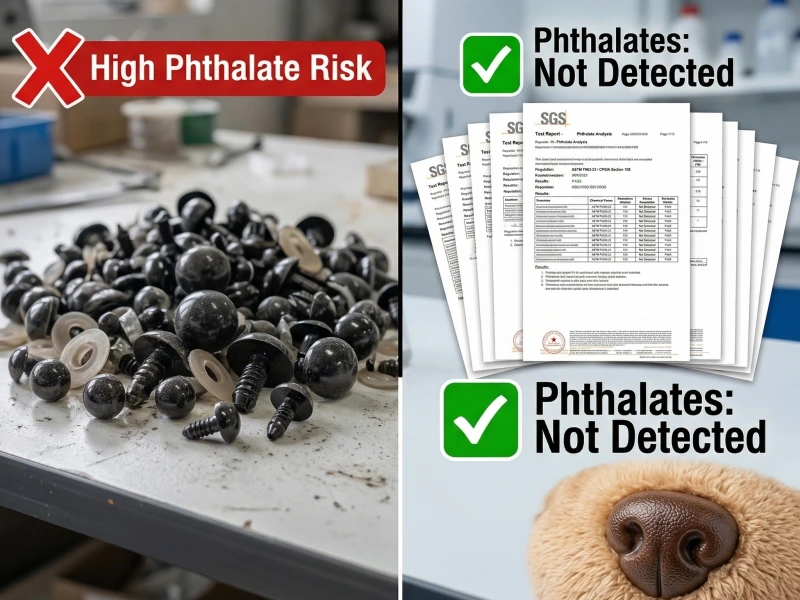
CPSIA enforces a strict legal ban on eight specific phthalates (chemical plasticizers) in children’s toys, limiting them to a maximum 0.1% concentration. To manufacture phthalate-free stuffed animals, B2B buyers must partner with a factory that explicitly specifies compliance before the injection molding of plastic eyes or PVC accessories.
If your plush design features hard components, you must be aware of phthalates. Phthalates are chemical plasticizers widely used in cheap industrial manufacturing to make hard plastics softer, more flexible, and more durable. Unfortunately, extensive medical research has identified them as severe endocrine disruptors, making them highly toxic to infants and toddlers who naturally place toys in their mouths.
The CPSC has permanently banned the use of eight specific phthalates (including DEHP, DBP, and BBP) in children's toys, restricting their presence to no more than 0.1%. If a customs agent tests your cargo and detects banned phthalates in a plastic zipper pull or a PVC branded keychain attached to your plush, the entire shipping container will be seized and potentially destroyed at your expense.
We protect your capital by engineering safety into the accessories from day one. If your custom mascot design requires a specific 3D plastic element—such as custom-shaped safety eyes or a branded PVC badge—we do not source these parts from generic wholesale catalogs.
To ensure you receive genuinely phthalate-free stuffed animals, we partner exclusively with strictly vetted, CPSIA-compliant injection molding facilities. We mandate the use of virgin, medical-grade plastics and alternative, non-toxic plasticizers (such as DINCH). We will happily provide material safety data sheets (MSDS) for these components, giving your legal team absolute confidence before mass production begins.
US regulations mandate strict flammability testing for all fabric toys. Laboratory technicians apply an open flame to the plush exterior to calculate the physical burn rate. To pass, the fabric must not burn faster than 0.1 inches per second, requiring the use of inherently flame-resistant materials like 100% high-density polyester.
Safety isn't just about chemicals; it is about physical properties. The US government enforces 16 CFR 1500.44 to ensure that a plush toy will not easily catch fire if exposed to a household hazard, such as a candle or a stovetop.
Material Flammability Performance Comparison:
| Fabric Material Type | ASTM F963 Burn Rate | US Compliance Risk | Factory Recommendation |
| 100% Polyester (Minky/Tricot) | Melts/Shrinks; < 0.1 in/sec | Extremely Low | ✅ Highly Recommended |
| Untreated Natural Cotton | Ignites; rapid flame spread | High (Often fails without treatment) | ❌ Not Recommended |
| Long Faux Fur (Acrylic) | High flash potential | Moderate to High | ⚠️ Requires strict density checks |
We want you to understand exactly what your product will undergo during third-party testing. Independent lab technicians will place the physical prototype of your custom plush toy in a draft-free testing chamber. They will apply a standardized open flame (typically a 16mm butane flame) directly to the exterior fabric for exactly three seconds.
They then carefully measure the speed at which the flame travels across the major axis of the toy. If the flame spreads faster than one-tenth of an inch per second (0.1 in/sec), the toy is classified as a hazardous flammable solid and fails the audit.
To ensure you pass this test without the need for expensive and potentially toxic chemical flame retardants, we strongly advise our B2B clients to utilize 100% polyester fabrics (such as Crystal Super Soft Minky or Spandex Tricot).
At a molecular level, polyester fibers do not readily ignite. When exposed to an open flame, they melt, shrink away from the heat source, and naturally self-extinguish. This inherent physical property is why high-density polyester is the foundation of our plush toy factory USA standard manufacturing process. It saves you testing headaches and guarantees compliance.
Under ASTM safety protocols, mechanical testing varies drastically based on your target audience. For ASTM F963 custom toys graded for ages 0-3, any attached component (eyes, noses, buttons) must withstand a 15-pound (70-Newton) tension test for 10 seconds without detaching, preventing fatal choking hazards.
We are highly proactive in helping you define your target audience, because the age grade you print on your packaging dictates the severity of the mechanical tests your toy must endure.
Many marketing departments want to label their plush toy packaging with "Safe for Ages 0+" to maximize retail appeal. However, doing so subjects your product to the most brutal physical testing parameters in the United States.
If your 2D design features hard plastic buttons on a jacket, or glued-on plastic eyes, it is in direct conflict with infant safety laws. During the lab audit, a technician will use a mechanical force gauge to pull those hard components with 15 pounds of force. If the fabric tears and the plastic eye pops out, it fails the "small parts cylinder test." The CPSC classifies this as a lethal choking hazard for an infant.
💡 Paper compliance means nothing without factory floor execution. Discover how we physically execute the 70-Newton pull test on our assembly line to guarantee you pass the external lab audit: [Bulk Plush QC: Needle Detection & Seam Strength Tests].
We do not want you to fail a lab test and have to pay for a redesign. Therefore, when manufacturing for the 0-3 demographic, our engineers proactively audit your Tech Pack. We will strongly recommend removing all hard plastic components and replacing them with high-density, industrial embroidery.
Because embroidery thread is permanently woven directly into the fabric's substrate, it is physically impossible for a child to bite it off or pull it loose. This manufacturing pivot completely bypasses the choking hazard failure point, ensuring your ASTM F963 custom toys pass the mechanical audit on the very first try.
💡 Need to understand the aesthetic and financial differences between embroidery and hard plastics? Read our B2B guide: [Plush Toy Embroidery vs. Printing: A B2B Manufacturing Guide].
You cannot legally import children's toys into the US without a valid Children's Product Certificate (CPC). This mandatory document must be drafted by the US importer and backed by passing test results from a CPSC-accepted, independent third-party laboratory. We coordinate directly with labs like SGS and Intertek to expedite your testing and ensure your paperwork is flawless.
A CPC certificate plush is not a simple warranty document that a Chinese factory can just print and hand to you. It is a strict legal declaration that you (the brand or procurement agency) must issue to the US government, certifying that your product complies with all applicable safety rules.
However, you cannot draft a CPC without empirical proof. This is where FactoryPlush steps in as your logistical partner, handling the heavy lifting of the testing process so you can focus on marketing and sales.

Because this testing is conducted by independent international laboratories to ensure unbiased results, B2B buyers must budget for the lab fees. Comprehensive testing for a standard CPSIA certified plush toy typically costs between $400 and $800. The process usually takes 7 to 10 business days.
We will help you optimize these costs. The final price fluctuates based on the complexity of your Bill of Materials (BOM). The lab must perform individual chemical breakdowns on every different fabric color, plastic component, and screen-printed logo. Our engineers will advise you on how to consolidate colors and materials during the design phase to keep your lab testing fees as low as possible.
We believe in complete transparency to protect your corporate liability. As your manufacturing partner, FactoryPlush guarantees that our materials are non-toxic, and we expertly manage the submission of your samples to the lab. However, under US federal law, the "Importer of Record" (your US-based brand, LLC, or corporation) bears the ultimate legal responsibility for drafting the CPC, maintaining the testing records, and presenting them to US Customs and Border Protection upon request.
We provide the pristine manufacturing and the verifiable data; you hold the keys to the US market. Together, we make a formidable team.
Yes. If the custom plush toy is designed or primarily intended for use by children 12 years of age or younger, CPSIA testing for lead and phthalates, along with ASTM F963 mechanical testing, is legally mandatory to import and sell the product in the United States.
No. By US federal law, the US-based importer of record is legally responsible for drafting and signing the CPC. However, a reliable plush toy factory will manage the submission of your pre-production samples to a CPSC-accepted third-party lab to secure the passing test reports you need to legally create the CPC.
Comprehensive third-party lab testing for a standard custom plush toy typically costs between $400 and $800. The exact price fluctuates based on the number of different fabric colors, plastic components, and printing inks that require individual chemical breakdowns.
If a component detaches during the ASTM 15-pound tension test, the lab issues a "Fail" report. The factory must immediately halt production, re-engineer the attachment method (such as increasing the seam allowance or switching to embroidered features), and submit a new sample for re-testing before mass manufacturing can legally begin.